首頁 > Case Studies
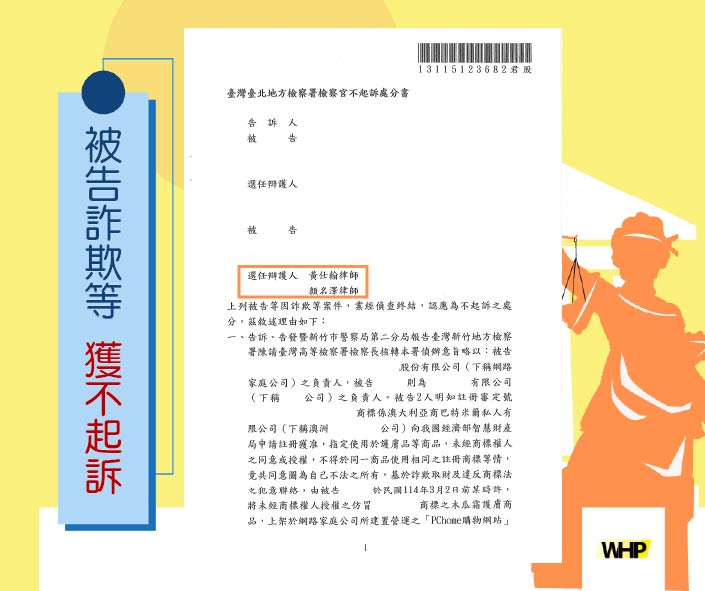
Case Studies | Criminal Case | No Prosecution for Alleged Counterfeit Sales and Fraud
Relevant Legal Provision
Article 339, Paragraph 1 of the Criminal Code:
A person who, with the intent to obtain an unlawful benefit for themselves or a third party, causes another person to deliver property belonging to themselves or a third party through fraudulent means shall be sentenced to imprisonment for not more than five years, short-term imprisonment, or a fine of not more than NT$500,000, or both.
Article 95, Subparagraph 1 of the Trademark Act:
A person who, without the consent of the owner of a registered trademark or collective trademark, uses a trademark identical to such registered trademark or collective trademark in connection with identical goods or services shall be sentenced to imprisonment for not less than one year but not more than three years, short-term imprisonment, or a fine of not more than NT$200,000, or both.
Facts and Reasons
The defendant, who was represented by our firm, was the responsible person of a technology company engaged in online retail operations.
The complainant alleged that a skincare product from a well-known Australian brand sold by the defendant was counterfeit and had not been authorized by the trademark owner. The product was listed and publicly offered for sale to consumers on a major online shopping platform.
The complainant claimed that they were misled into purchasing the product and only realized that they might have been deceived after receiving it and noticing differences in its quality. The complainant subsequently filed a criminal complaint against the defendant.
Prosecutor's Disposition
Following the completion of the investigation into the alleged fraud and related offenses, the District Prosecutors Office concluded that a non-prosecution disposition should be issued.
Regarding the alleged fraud and Trademark Act violations, the complaint was primarily based on the assertion that, after inquiries were made through several channels, the original manufacturer stated that the production batch number shown on the product did not exist.
However, the coding, registration, and verification of product batch numbers are generally matters of internal management between trademark owners and their regional distributors in different countries. Batch numbers and authentication methods may also vary depending on parallel-import channels, regional anti-counterfeiting labels, or local distributors.
Furthermore, according to the shopping platform's inquiry with the original manufacturer, the information concerning the brand's authorized distributor in Taiwan was inconsistent with the complainant’s statements.
It was therefore difficult to conclude, solely on the basis of the complainant's unilateral assertion that a particular batch number did not exist, that the product in question was necessarily counterfeit. Nor could it be readily inferred that the defendant knew the product was counterfeit when it was offered for sale.
The defendant purchased the disputed products from a supplier through legitimate commercial channels. The supplier also submitted supporting documents, including tax invoices, commercial invoices, triplicate government uniform invoices, and customs certificates showing the payment of taxes and charges for imported express cargo.
These documents were sufficient to establish that the products sold by the defendant had been imported from Australia and that the defendant had a reasonable and trustworthy source of supply. It was therefore evident that the defendant did not knowingly sell counterfeit products.
In addition, when shipping the products, the defendant voluntarily and clearly disclosed their personal and company information on the outer packaging.
Had the defendant deliberately intended from the outset to sell counterfeit goods for unlawful profit, it would have been more consistent with ordinary experience for the defendant to conceal their true identity and company information in order to avoid investigation and prosecution.
This circumstance further supported the defendant's explanation that they genuinely believed the products to be authentic and had no criminal intent from the outset. The explanation was consistent with both common experience and logical reasoning and was therefore deemed credible.
In conclusion, the defendant's explanation was supported by the evidence and could reasonably be accepted.
The complainant's unilateral allegations alone were insufficient to establish that the defendant had committed fraud, trademark infringement, or any related offense. No other affirmative evidence was discovered that could prove the alleged criminal conduct.
Accordingly, the prosecutor determined that there was insufficient evidence to establish the defendant's criminal liability and issued a non-prosecution disposition.
(Some details of the case have been adjusted, deleted, or modified to protect the rights and interests of the client.)
-
07.28 2026Case Studies
Criminal Case | No Prosecution for Alleged Counter...
-
07.21 2026Case Studies
Criminal Case | Acquitted of Falsifying Board Meet...
-
07.14 2026Case Studies
Criminal | Non-Prosecution in Neighbor Defamation ...
-
07.07 2026Case Studies
Criminal Case | Prosecution Secured in Mobile Phon...
-
06.30 2026Case Studies
Bank Account Frozen in Taiwan? How to Remove Flagg...
-
06.02 2026Case Studies
Criminal | Perjury Non-Prosecution
-
05.12 2026Case Studies
Criminal | Secret Filming Case Successfully Settle...
-
05.05 2026Case Studies
Criminal | Fraud Aider Identified — Defrauded Fund...
-
04.07 2026Case Studies
Civil | Property Returned but Interior Damaged — P...
-
03.24 2026Case Studies
Criminal | LINE Investment Fraud — Syndicate Buste...
-
03.17 2026Case Studies
Criminal | Procurement Act Violation — Deferred Pr...
-
03.10 2026Case Studies
Civil | Breach of Agreement — Favorable Judgment O...
-
03.03 2026Case Studies
Criminal | Embezzlement & Fraud Case — Non-Prosecu...
-
02.24 2026Case Studies
Owner Failed to Properly Manage Pet Dog That Bit a...
-
02.10 2026Case Studies
Divorce | Successfully Won Custody of Minor Childr...