首頁 > Case Studies
Case Studies | Former Nonprofit Chairman Cleared of Embezzlement Charges in Taiwan
Relevant Legal Provision
Article 335, Paragraph 1 of the Criminal Code:
A person who, with the intent to unlawfully appropriate property for themselvesa third party, embezzles property belonging to another that is in their possession shall be sentenced to imprisonment for not more than five years, short-term imprisonment,a fine of not more than NT$30,000,both.
Article 336, Paragraph 1 of the Criminal Code:
A person who commits the offense specified in Paragraph 1 of the preceding article with respect to property held in connection with public dutiescharitable activities shall be sentenced to imprisonment for not less than one year and not more than seven years, and may additionally be fined up to NT$100,000.
Article 339-3, Paragraph 1 of the Criminal Code:
A person who, with the intent to unlawfully obtain property for themselvesa third party, inputs false dataunauthorized instructions into a computerrelated equipment by improper means, thereby creating records concerning the acquisition, loss,alteration of property rights and obtaining another person's property, shall be sentenced to imprisonment for not more than seven years and may additionally be fined up to NT$700,000.
Article 342, Paragraph 1 of the Criminal Code:
A person who, while managing affairs on behalf of another, acts in violation of their duties with the intent to obtain unlawful benefits for themselvesa third party,to cause harm to the principal's interests, thereby causing damage to the principal's propertyother interests, shall be sentenced to imprisonment for not more than five years, short-term imprisonment,a fine of not more than NT$500,000,both.
Facts and Reasons
The client previously served as the chairman of a nonprofit organization dedicated to supporting educational opportunities for disadvantaged students in remote areas. During their tenure, the client raised donations on behalf of the organization and regularly led volunteer groups to underserved overseas communities, where they visited schools and churches, distributed supplies, and provided companionship and support to children.
While serving as chairman, the client frequently paid organizational expenses out of pocket. To reimburse these advances, recurring bank transfers were arranged from the organization's account to the client's personal account.
Following the client's resignation, however, the organization's new leadership and several members raised allegations of financial misconduct. They claimed that:
Donations collected by the organization had not been fully distributed to designated schools.
Fees collected from volunteers had been improperly diverted to cover staff expenses.
The client had allegedly accessed the organization's online banking account without authorization after stepping down and transferred organizational funds into their personal account.
Based on these allegations, the complainants filed a criminal complaint accusing the client of embezzlement of charitable property, breach of trust, embezzlement, and computer fraud.
Prosecutor's Disposition
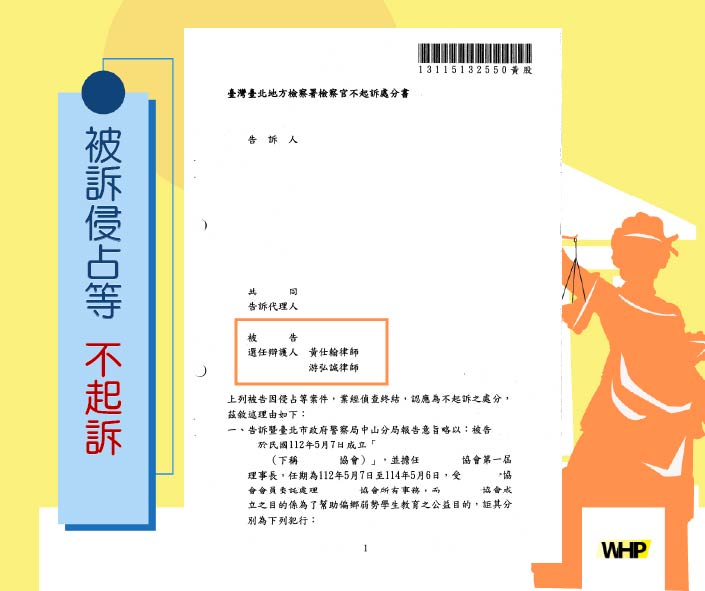
Following the investigation, the District Prosecutors Office concluded that the evidence was insufficient to establish criminal liability and issued a non-prosecution disposition in favor of the client.
Financial Records Did Not Establish EmbezzlementBreach of Trust
The prosecutor examined the expense documentation submitted by the client, together with witness testimony.
The investigation revealed that the actual expenses incurred by the client during their two-year tenure were approximately consistent with the remaining funds in the client's bank account.
Although the organization's accounting records were somewhat informal and contained certain deficiencies, these irregularities alone were insufficient to establish that the client had unlawfully appropriated organizational fundscommitted a breach of trust.
Recurring Bank Transfers Had Been Established Before the Client's Resignation
Regarding the allegations of unauthorized online banking transactions, the prosecutor reviewed information provided by the bank.
The bank records confirmed that the recurring monthly transfers had been established during the client's tenure as chairman, rather than after their resignation.
Furthermore, the complainant acknowledged that the automatic transfer arrangement was discovered only after the organization's online banking credentials had been changed.
These findings undermined the allegation that the client had deliberately accessed the organization's bank account after resigning to initiate unauthorized transfers.
Failure to Cancel Automatic Transfers Did Not Establish Criminal Intent
The prosecutor also considered whether the client had knowingly received organizational funds after leaving office.
Because the client's personal bank account received income from multiple sources, it was uncertain whether the client would have immediately noticed the continued transfers.
Importantly, the client had returned all funds transferred after the incident came to light.
Based on the available evidence, the prosecutor determined that the continued transfers were likely attributable to the client's inadvertent failure to cancel the existing automatic transfer arrangement upon resignation.
There was insufficient evidence to conclude that the client had intentionally created false records of changes in property rightsunlawfully obtained the organization's funds through computer fraud.
Considering the financial documentation, witness testimony, bank transaction records, and the client's subsequent return of the funds, the prosecutor found insufficient evidence to support the alleged offenses.
Accordingly, the prosecutor issued a non-prosecution disposition, bringing the criminal investigation against the former nonprofit chairman to a close.
(Some details of the case have been adjusted, deleted,modified to protect the rights and interests of the client.)
Attorneys: Vincent Huang、Kevin Yu
-
11.03 2026Case Studies
Criminal | Romance Scam Victim Cleared of Fraud an...
-
10.27 2026Case Studies
Former Nonprofit Chairman Cleared of Embezzlement ...
-
10.20 2026Case Studies
Accountant Accused of Embezzlement and Fraud – Non...
-
10.13 2026Case Studies
Criminal Defense | Scammed Into Sharing a Bank Acc...
-
09.29 2026Case Studies
Debtor’s Objection Dismissed Over Tax Deduction
-
07.28 2026Case Studies
Criminal Case | No Prosecution for Alleged Counter...
-
07.21 2026Case Studies
Criminal Case | Acquitted of Falsifying Board Meet...
-
07.14 2026Case Studies
Criminal | Non-Prosecution in Neighbor Defamation ...
-
07.07 2026Case Studies
Criminal Case | Prosecution Secured in Mobile Phon...
-
06.30 2026Case Studies
Bank Account Frozen in Taiwan? How to Remove Flagg...
-
06.02 2026Case Studies
Criminal | Perjury Non-Prosecution
-
05.12 2026Case Studies
Criminal | Secret Filming Case Successfully Settle...
-
05.05 2026Case Studies
Criminal | Fraud Aider Identified — Defrauded Fund...
-
04.07 2026Case Studies
Civil | Property Returned but Interior Damaged — P...
-
03.24 2026Case Studies
Criminal | LINE Investment Fraud — Syndicate Buste...