首頁 >
| Criminal Defense | Scammed Into Sharing a Bank Account, Cleared of Fraud Charges
Relevant Legal Provision
Article 339, Paragraph 1 of the Criminal Code:
A person who, with the intent to unlawfully obtain property for themselvesa third party, uses deception to cause another person to deliver property belonging to themselvesa third party shall be punished by imprisonment for not more than five years, short-term imprisonment,a fine of not more than NT$500,000,both imprisonment and a fine.
Article 19, Paragraph 1 of the Money Laundering Control Act:
A person who commits any of the money laundering acts specified in Article 2 shall be punished by imprisonment for not less than three years and not more than ten years, in addition to a fine of not more than NT$100 million. If the propertyproperty interests involved in the money laundering amount to less than NT$100 million, the person shall be punished by imprisonment for not less than six months and not more than five years, in addition to a fine of not more than NT$50 million.
Facts and Reasons
The defendant contacted an individual online who claimed to offer assistance with loan eligibility assessments. Under the pretext that the defendant needed to “improve their financial transaction records” to qualify for a loan, the individual requested the defendant's online banking account credentials, including the account number and password. The defendant was also instructed to add a purported loan agentdocument preparer (“shūshì”) on a messaging app, cooperate with SMS and video verification procedures, and set up designated transfer arrangements. The individual even asked the defendant to print and sign documents, then photograph and return them.
Shortly thereafter, substantial sums of money began arriving in the defendant’s bank account and were promptly transferred out by the other party. The individual subsequently instructed the defendant to transfer the small amounts remaining in the account to several designated accounts. The defendant complied, transferring some of their own money as well.
The defendant later discovered that the bank account had been flagged as a suspicious account. When the defendant asked the individual what to do, the individual stopped responding. Realizing that something was wrong, the defendant immediately went to a local police station to report the incident.
Separately, another individual who had been deceived by a fraud syndicate transferred money into the defendant's account. After the victim reported the incident to the police, the police suspected that the defendant had facilitated fraud and money laundering by providing the bank account and transferring the funds. The case was subsequently referred to the district prosecutors office for investigation.
Prosecutor's Disposition
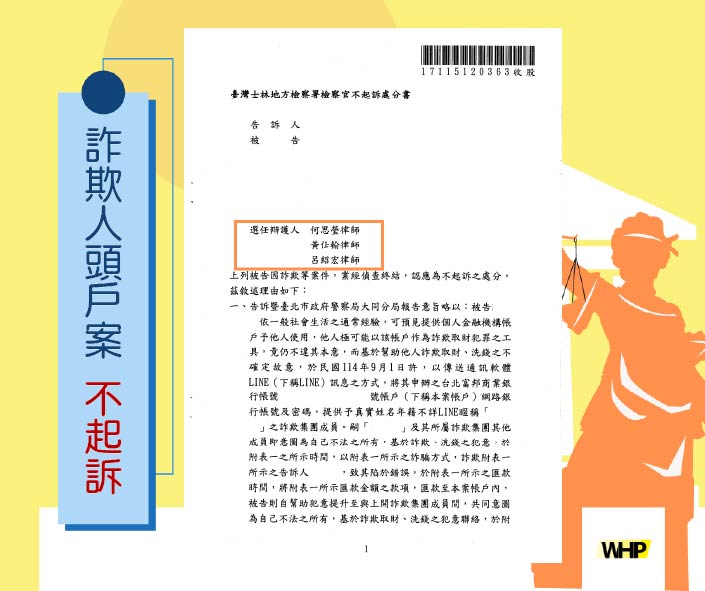
Upon completing the investigation into the defendant for fraud and other alleged offenses, the prosecutor determined that the case warranted a decision not to prosecute.
Criminal facts must be established by evidence, and no criminal fact may be found without supporting evidence. Any finding of fact adverse to the defendant must be supported by affirmative evidence. If such evidence is insufficient, the facts must be determined in the defendant's favor.
Upon examination, the prosecutor reviewed the messaging records between the defendant and the other party. The records showed that the other party initially offered assistance with a loan eligibility assessment, asked the defendant to provide personal information, instructed the defendant to add a purported loan agent on a messaging app, and required cooperation with SMS and video verification procedures. The other party also instructed the defendant to establish reciprocal designated transfer arrangements and subsequently requested that the defendant print, sign, and return documents.
When the defendant discovered that funds had been transferred out of the account, the defendant questioned the other party, who responded that the loan agent was “making records.” Later, when the defendant discovered that the account had been flagged as a suspicious account and asked how to handle the situation, the other party ceased responding.
These messages were consistent with the defendant’s account that the other party had claimed the funds were needed to “improve financial transaction records,” had transferred out the substantial sums, and had instructed the defendant to transfer the remaining funds to multiple accounts. The defendant’s explanation was therefore supported by the evidence and could not be dismissed as fabricated. Accordingly, the evidence was insufficient to establish that the defendant had the requisite criminal intent to jointly commit fraud and money laundering with members of the fraud syndicate.
Furthermore, the defendant had also been deceived by the other party’s representations and had transferred money to an account designated by that individual, thereby suffering personal financial losses. After noticing the suspicious circumstances, the defendant promptly reported the matter to the police, as confirmed by the official report acknowledgment. These facts further supported the conclusion that the defendant had neither the intent to commit nor actually committed fraudmoney laundering.
No other affirmative evidence in the case file was sufficient to establish that the defendant had committed the offenses alleged in the criminal complaintreport. The prosecutor therefore found insufficient evidence to establish criminal involvement and, pursuant to Article 252, Subparagraph 10 of the Code of Criminal Procedure, issued a non-indictment disposition.
(Some details of the case have been adjusted, deleted,modified to protect the rights and interests of the client.)
Attorneys: Vincent Huang、 Herman Lyu、Doris Ho
-
10.20 2026
Accountant Accused of Embezzlement and Fraud – Non...
-
10.13 2026
Criminal Defense | Scammed Into Sharing a Bank Acc...
-
09.29 2026
Debtor’s Objection Dismissed Over Tax Deduction
-
07.28 2026
Criminal Case | No Prosecution for Alleged Counter...
-
07.21 2026
Criminal Case | Acquitted of Falsifying Board Meet...
-
07.14 2026
Criminal | Non-Prosecution in Neighbor Defamation ...
-
07.07 2026
Criminal Case | Prosecution Secured in Mobile Phon...
-
06.30 2026
Bank Account Frozen in Taiwan? How to Remove Flagg...
-
06.02 2026
Criminal | Perjury Non-Prosecution
-
05.12 2026
Criminal | Secret Filming Case Successfully Settle...
-
05.05 2026
Criminal | Fraud Aider Identified — Defrauded Fund...
-
04.07 2026
Civil | Property Returned but Interior Damaged — P...
-
03.24 2026
Criminal | LINE Investment Fraud — Syndicate Buste...
-
03.17 2026
Criminal | Procurement Act Violation — Deferred Pr...
-
03.10 2026
Civil | Breach of Agreement — Favorable Judgment O...