首頁 > Case Studies
Case Studies | Debtor’s Objection Dismissed Over Tax Deduction
Relevant Legal Provision
Article 98 of the Civil Code:In interpreting a declaration of intention, the true intention of the parties shall be sought rather than adhering strictly to the wording used.
Article 737 of the Civil Code:A settlement has the effect of extinguishing the rights relinquished by the parties and granting the parties the rights expressly provided for in the settlement agreement.
Facts and Reasons
This case arose from a lease dispute. The plaintiff and the decedent of this Firm's client had previously been involved in litigation concerning the payment of rent. The court of first instance ruled that the plaintiff was required to pay rent and default interest. Dissatisfied with the judgment, the plaintiff filed an appeal.
During the appellate proceedings, the parties reached a court-mediated settlement, under which the plaintiff agreed to pay a specified sum within a certain period. The settlement further provided that, if payment was not made within the agreed period, the plaintiff would additionally be liable for a punitive penalty and interest.
However, when making the remittance, the plaintiff unilaterally deducted “rental income tax” and “supplementary National Health Insurance premiums,” and paid only the remaining balance after such deductions. As a result, the amount actually paid was less than the amount stipulated in the settlement record.
After this Firm's client subsequently discovered the shortfall in the remittance, an application for compulsory enforcement was filed based on the unpaid portion under the settlement record. The plaintiff, in turn, filed a “debtor's objection action,” asserting that the debt stated in the settlement record had been fully discharged through the remittance, and requesting the court to revoke the compulsory enforcement proceedings and confirm that the claim no longer existed.
Judgment
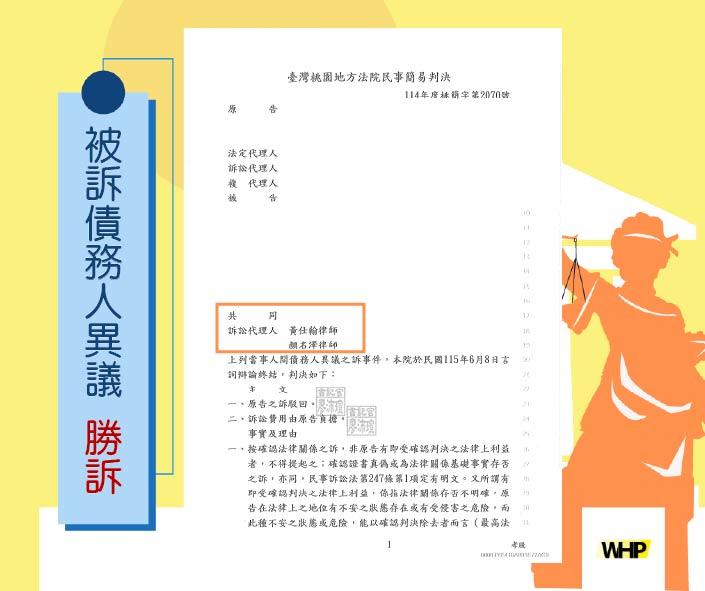
In the debtor's objection action between the above parties, the court dismissed the plaintiff's action and ordered the plaintiff to bear the litigation costs.
The court held that the settlement record in this case constituted a “constitutive settlement,” meaning that the parties had abandoned the original lease-related legal relationship and entered into a new agreement regarding the amount to be paid, rather than continuing the original legal relationship and calculating tax-related deductions on that basis.
Upon reviewing the communications exchanged during the formation of the settlement record, the court found that the parties had repeatedly confirmed details such as the total payment amount, penalties for late payment, and interest during their negotiations. However, there had never been any mention of deducting rental income tax, supplementary National Health Insurance premiums,similar charges. Nor did the settlement record itself contain any provision concerning such deductions.
Pursuant to the first sentence of Article 277 of the Code of Civil Procedure, the plaintiff bore the burden of proving facts favorable to its own claim, namely, that full payment had been made in accordance with the agreement. However, the testimony of the witness presented by the plaintiff was clearly inconsistent with the plaintiff's own assertions and was insufficient to prove that, prior to making the remittance, the plaintiff had confirmed with the opposing partyits litigation representative that taxes and related charges could be deducted. Accordingly, the court did not accept this part of the plaintiff's argument.
Because there was indeed a difference between the payment amount stipulated in the settlement record and the amount actually remitted by the plaintiff, and because the plaintiff had failed to fully perform its obligations as agreed, the plaintiff was also required, pursuant to the settlement record, to pay an additional punitive penalty.
Accordingly, this Firm's client had a valid legal basis for applying for compulsory enforcement under the settlement record. The plaintiff's assertions that the debt had been fully discharged and that other damages claims could be used as a set-off were likewise found by the court to be without merit.
In conclusion, the court determined that the plaintiff's action was without merit and dismissed the action in its entirety. This Firm's client successfully maintained the existing enforceable title and protected the rights and interests to which the client was entitled under the settlement record.
(Note: To protect the client's interests, certain case details and judgment images have been redacted and modified. For a full review of the case, please refer to Judicial Yuan's judgment database)
Attorneys:Vincent Huang、Ian Yan
-
09.29 2026Case Studies
Debtor’s Objection Dismissed Over Tax Deduction
-
07.28 2026Case Studies
Criminal Case | No Prosecution for Alleged Counter...
-
07.21 2026Case Studies
Criminal Case | Acquitted of Falsifying Board Meet...
-
07.14 2026Case Studies
Criminal | Non-Prosecution in Neighbor Defamation ...
-
07.07 2026Case Studies
Criminal Case | Prosecution Secured in Mobile Phon...
-
06.30 2026Case Studies
Bank Account Frozen in Taiwan? How to Remove Flagg...
-
06.02 2026Case Studies
Criminal | Perjury Non-Prosecution
-
05.12 2026Case Studies
Criminal | Secret Filming Case Successfully Settle...
-
05.05 2026Case Studies
Criminal | Fraud Aider Identified — Defrauded Fund...
-
04.07 2026Case Studies
Civil | Property Returned but Interior Damaged — P...
-
03.24 2026Case Studies
Criminal | LINE Investment Fraud — Syndicate Buste...
-
03.17 2026Case Studies
Criminal | Procurement Act Violation — Deferred Pr...
-
03.10 2026Case Studies
Civil | Breach of Agreement — Favorable Judgment O...
-
03.03 2026Case Studies
Criminal | Embezzlement & Fraud Case — Non-Prosecu...
-
02.24 2026Case Studies
Owner Failed to Properly Manage Pet Dog That Bit a...