首頁 >
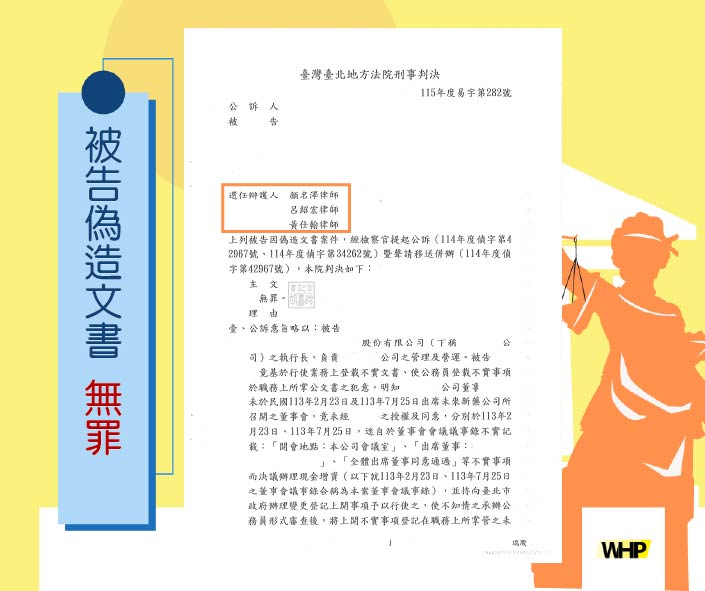
| Criminal Case | Acquitted of Falsifying Board Meeting Minutes
Relevant Legal Provision
Article 214 of the Criminal Code:A person who knowingly causes a public official to enter a false statement in an official document prepared in the course of the official's duties, where such act is sufficient to cause harm to the public or another person, shall be sentenced to imprisonment for not more than three years, short-term imprisonment, or a fine of not more than NT$15,000.
Article 215 of the Criminal Code:A person engaged in a profession or occupation who knowingly records a false statement in a document prepared in the course of their professional duties, where such act is sufficient to cause harm to the public or another person, shall be sentenced to imprisonment for not more than three years, short-term imprisonment, or a fine of not more than NT$15,000.
Facts and Reasons
The defendant, who was represented by our firm, served as the chief executive officer of a company and was responsible for managing and operating its external business affairs.
The prosecutor alleged that the company had recorded the name of a director who did not attend a board meeting in the section listing the directors present. The meeting minutes also stated that the relevant resolution had been “unanimously approved by all directors present.”
The board meeting minutes were subsequently submitted to the competent authority for the registration of corporate changes. Following a formal review, an official who was unaware of the alleged inaccuracies entered the information into an official document maintained in the course of official duties.
The prosecutor therefore indicted the defendant for allegedly using a business document containing false statements and causing a public official to enter false information in an official document.
Judgment
The defendant was prosecuted for document-related offenses and was ultimately found not guilty.
Criminal facts must be established by evidence, and no criminal conduct may be found in the absence of sufficient proof. Where the evidence is insufficient to establish that the defendant committed the alleged offense, the court must render a judgment of acquittal.
Regarding the alleged offense of recording false information in a business document, the court found no evidence in the case record demonstrating that the defendant's occupational responsibilities or job duties included the preparation of board meeting minutes. It was therefore difficult to conclude that the defendant's conduct satisfied the elements of Article 215 of the Criminal Code.
Regarding the alleged offense of causing a public official to enter false information in an official document, although the meeting minutes listed the name of a director who had not attended the meeting, the format and narrative style of the company's previous board meeting minutes were identical to those used in the disputed minutes.
Furthermore, the attendance sheet attached to the minutes identified directors who differed from those listed in the minutes. This indicated that the disputed minutes had likely been prepared using a previous template that was inadvertently left uncorrected.
Accordingly, the defendant did not knowingly submit false information or possess the intent required for the offense of causing a public official to enter false information in an official document.
In addition, another company involved in a separate case concerning the same circumstances had already received a non-prosecution disposition based on substantially similar reasoning. This further supported the possibility that an outdated template had been used without proper revision, rather than that the documents had been intentionally falsified.
After reviewing all evidence submitted by the prosecutor, the court concluded that there was insufficient proof that the defendant had committed document falsification or any related offense.
The prosecutor's evidence did not reach the level necessary to eliminate reasonable doubt and establish the defendant’s guilt with the degree of certainty ordinarily required in criminal proceedings. Based on the presumption of innocence, the court adopted the interpretation favorable to the defendant and rendered a judgment of acquittal.
(Note: To protect the client's interests, certain case details and judgment images have been redacted and modified. For a full review of the case, please refer to Judicial Yuan's judgment database)
Attorneys:Vincent Huang、 Herman Lyu、Ian Yan
-
10.20 2026
Accountant Accused of Embezzlement and Fraud – Non...
-
10.13 2026
Criminal Defense | Scammed Into Sharing a Bank Acc...
-
09.29 2026
Debtor’s Objection Dismissed Over Tax Deduction
-
07.28 2026
Criminal Case | No Prosecution for Alleged Counter...
-
07.21 2026
Criminal Case | Acquitted of Falsifying Board Meet...
-
07.14 2026
Criminal | Non-Prosecution in Neighbor Defamation ...
-
07.07 2026
Criminal Case | Prosecution Secured in Mobile Phon...
-
06.30 2026
Bank Account Frozen in Taiwan? How to Remove Flagg...
-
06.02 2026
Criminal | Perjury Non-Prosecution
-
05.12 2026
Criminal | Secret Filming Case Successfully Settle...
-
05.05 2026
Criminal | Fraud Aider Identified — Defrauded Fund...
-
04.07 2026
Civil | Property Returned but Interior Damaged — P...
-
03.24 2026
Criminal | LINE Investment Fraud — Syndicate Buste...
-
03.17 2026
Criminal | Procurement Act Violation — Deferred Pr...
-
03.10 2026
Civil | Breach of Agreement — Favorable Judgment O...