首頁 > Case Studies
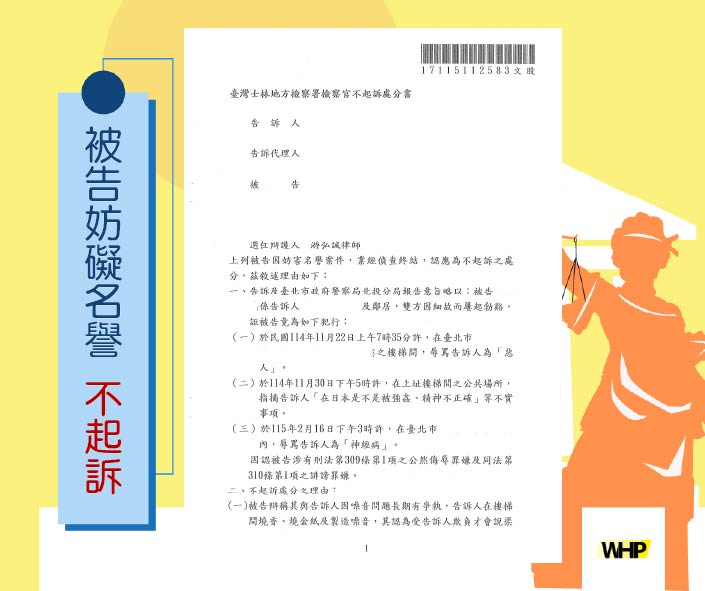
Case Studies | Criminal | Non-Prosecution in Neighbor Defamation Case
Relevant Legal Provision
Article 309, Paragraph 1 of the Criminal Code:
A person who publicly insults another shall be punished by short-term imprisonment or a fine of up to NT$9,000.
Article 310, Paragraph 1 of the Criminal Code:
A person who, with the intent to disseminate the statement to the public, alleges or circulates a fact capable of damaging another person's reputation commits the offense of defamation and shall be punished by imprisonment for up to one year, short-term imprisonment, or a fine of up to NT$15,000.
Facts and Reasons
The defendant, who was represented by our firm, and the complainant were neighbors residing in the same building. The parties had a history of disputes arising from noise and other minor issues.
The complainant alleged that the defendant had verbally insulted the complainant and made false accusations in public areas, including the building stairwell and a park. The complainant therefore filed a criminal complaint with the District Prosecutors Office, accusing the defendant of public insult and defamation.
Prosecutor's Disposition
Following the conclusion of the investigation into the alleged offenses against reputation, the prosecutor determined that a non-prosecution disposition should be issued.
Public Insult
According to the video recording submitted by the complainant, the defendant made the disputed statements while the parties were engaged in a heated argument. Both parties were emotionally agitated, and the defendant's remarks appeared to have been an impulsive verbal reaction made in the heat of the moment.
Taking into account the parties'personal circumstances, including their gender, age and occupations, as well as their relationship, the defendant's motive and purpose, level of education, customary manner of speaking, the provocation experienced at the time, and the wording, tone, context and sequence of the statements, the prosecutor found that the defendant's language, although inappropriate, coarse and strongly worded, was primarily sarcastic, mocking and dismissive in nature.
While the remarks may have caused the complainant discomfort or embarrassment, the evidence was insufficient to establish that the defendant acted with the criminal intent required for the offense of public insult.
Moreover, an ordinary person who witnessed the incident would have understood that the statements arose from a momentary dispute between neighbors with a pre-existing conflict. The remarks did not objectively diminish the complainant’s social reputation or personal standing. Accordingly, the defendant could not be held criminally liable for public insult solely on the basis of those statements.
Defamation
Freedom of speech is a fundamental right expressly protected under Article 11 of the Constitution.
The offense of defamation under Article 310, Paragraph 1 of the Criminal Code requires that a person, with the intent to disseminate information to the public, allege or circulate a fact capable of damaging another person's reputation.
In addition to objectively alleging or communicating a potentially reputation-damaging fact, the accused must also subjectively possess the intent to harm the other person's reputation. Where there is insufficient evidence to establish that the accused acted maliciously, the statements should be presumed to have been made in good faith.
According to the video submitted by the complainant, before the defendant made the disputed statement, the complainant continued loudly expressing demands toward the defendant, who had already returned upstairs, for approximately five minutes. The defendant’s statement was therefore made in response to the complainant's continued shouting in the stairwell after the defendant had already left the immediate scene.
Furthermore, the disputed statement was phrased as a question rather than as an affirmative assertion of fact. It was therefore difficult to conclude that the defendant had fabricated or intentionally disseminated false information.
After the defendant made the statement, the complainant continued loudly addressing the absent defendant in the stairwell for approximately 30 minutes and repeatedly referred to the defendant’s statement during that period.
Given that the complainant also maintained that the stairwell was a public area, these circumstances further indicated that the complainant did not appear concerned as to whether the statement would be disseminated to others. The evidence was therefore insufficient to establish that the statement had reached the level of damaging the complainant's reputation.
Based on the foregoing, the prosecutor concluded that there was insufficient evidence to establish that the defendant had committed the alleged offenses and therefore issued a non-prosecution disposition.
(Some details of the case have been adjusted, deleted, or modified to protect the rights and interests of the client.)
-
07.28 2026Case Studies
Criminal Case | No Prosecution for Alleged Counter...
-
07.21 2026Case Studies
Criminal Case | Acquitted of Falsifying Board Meet...
-
07.14 2026Case Studies
Criminal | Non-Prosecution in Neighbor Defamation ...
-
07.07 2026Case Studies
Criminal Case | Prosecution Secured in Mobile Phon...
-
06.30 2026Case Studies
Bank Account Frozen in Taiwan? How to Remove Flagg...
-
06.02 2026Case Studies
Criminal | Perjury Non-Prosecution
-
05.12 2026Case Studies
Criminal | Secret Filming Case Successfully Settle...
-
05.05 2026Case Studies
Criminal | Fraud Aider Identified — Defrauded Fund...
-
04.07 2026Case Studies
Civil | Property Returned but Interior Damaged — P...
-
03.24 2026Case Studies
Criminal | LINE Investment Fraud — Syndicate Buste...
-
03.17 2026Case Studies
Criminal | Procurement Act Violation — Deferred Pr...
-
03.10 2026Case Studies
Civil | Breach of Agreement — Favorable Judgment O...
-
03.03 2026Case Studies
Criminal | Embezzlement & Fraud Case — Non-Prosecu...
-
02.24 2026Case Studies
Owner Failed to Properly Manage Pet Dog That Bit a...
-
02.10 2026Case Studies
Divorce | Successfully Won Custody of Minor Childr...