首頁 > Case Studies
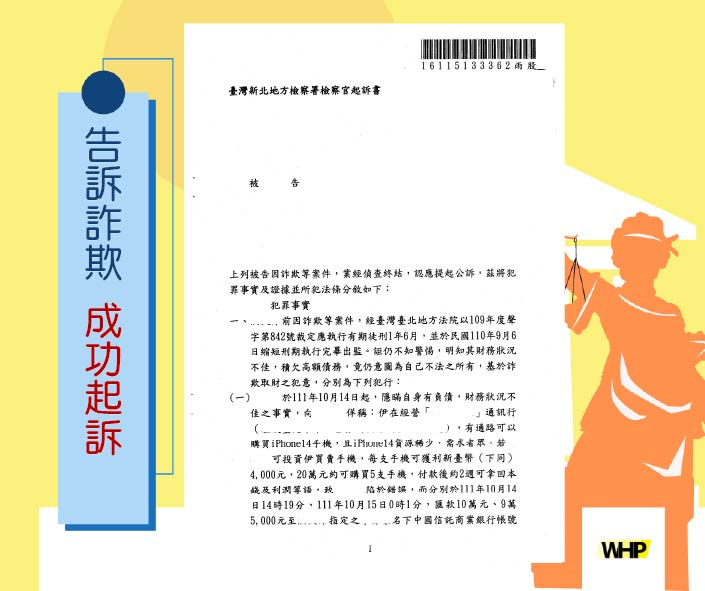
Case Studies | Criminal Case | Prosecution Secured in Mobile Phone Fraud Case
Relevant Legal Provision
Article 339, Paragraph 1 of the Criminal Code:A person who, with the intent to obtain unlawful ownership for himself/herself or a third party, causes another person to deliver property belonging to that person or a third party by means of deception shall be sentenced to imprisonment for not more than five years, short-term imprisonment, or a fine of not more than NT$500,000, or a combination thereof.
Facts and Reasons
The defendant concealed the fact that he was in poor financial condition and owed substantial debts. He falsely claimed to be operating a mobile phone store and used different fraudulent statements to deceive several complainants, including our client.
With respect to our client, the defendant repeatedly claimed that his mobile phone business was facing cash-flow difficulties and asked our client to use credit cards to purchase multiple iPhone 15 Pro and iPhone 15 Pro Max devices on his behalf. The defendant promised to repay the amounts when due and to provide additional mobile phones as compensation.
As a result, our client was misled and, on multiple occasions, purchased mobile phones by credit card and transferred funds to the defendant. The total loss exceeded NT$1 million. However, after receiving the mobile phones, the defendant failed to repay the amounts or deliver the promised phones.
The defendant had previously been convicted in a fraud case and was released after serving a prison sentence imposed by the court. Nevertheless, he failed to learn from his prior conviction and once again used similar methods to commit fraud against several complainants. The complainants therefore filed criminal complaints with the police in accordance with the law.
Prosecutor's Disposition
Following the conclusion of the investigation, the District Prosecutors Office determined that the defendant should be prosecuted for fraud and related offenses.
The defendant's conduct was deemed to constitute the offense of fraud under Article 339 Paragraph 1 of the Criminal Code.
The defendant committed multiple fraudulent acts against each complainant within a close period of time, using the same methods and infringing upon the same legal interest. The independence of each act was extremely weak. From the perspective of general social norms, it would be difficult to forcibly separate the acts. Therefore, for purposes of criminal law evaluation, the acts should be regarded as a continuing execution of one overall act and treated as an inclusive single offense.
In addition, the defendant had prior criminal records as stated in the facts of the case, as confirmed by the criminal case records on file. Since the defendant intentionally committed another offense punishable by imprisonment within five years after completing the execution of a previous prison sentence, the defendant is considered a repeat offender. The prosecutor therefore requested that the court increase the sentence pursuant to Article 47, Paragraph 1 of the Criminal Code.
(Some details of the case have been adjusted, deleted, or modified to protect the rights and interests of the client.)
-
07.28 2026Case Studies
Criminal Case | No Prosecution for Alleged Counter...
-
07.21 2026Case Studies
Criminal Case | Acquitted of Falsifying Board Meet...
-
07.14 2026Case Studies
Criminal | Non-Prosecution in Neighbor Defamation ...
-
07.07 2026Case Studies
Criminal Case | Prosecution Secured in Mobile Phon...
-
06.30 2026Case Studies
Bank Account Frozen in Taiwan? How to Remove Flagg...
-
06.02 2026Case Studies
Criminal | Perjury Non-Prosecution
-
05.12 2026Case Studies
Criminal | Secret Filming Case Successfully Settle...
-
05.05 2026Case Studies
Criminal | Fraud Aider Identified — Defrauded Fund...
-
04.07 2026Case Studies
Civil | Property Returned but Interior Damaged — P...
-
03.24 2026Case Studies
Criminal | LINE Investment Fraud — Syndicate Buste...
-
03.17 2026Case Studies
Criminal | Procurement Act Violation — Deferred Pr...
-
03.10 2026Case Studies
Civil | Breach of Agreement — Favorable Judgment O...
-
03.03 2026Case Studies
Criminal | Embezzlement & Fraud Case — Non-Prosecu...
-
02.24 2026Case Studies
Owner Failed to Properly Manage Pet Dog That Bit a...
-
02.10 2026Case Studies
Divorce | Successfully Won Custody of Minor Childr...