首頁 > Case Studies
Case Studies | Bank Account Frozen in Taiwan? How to Remove Flagged Account Status — A Complete Guide
Relevant Legal Provisions
Article 210 of the Criminal Code:A person who forges or alters a private document in a manner sufficient to cause damage to the public or another person shall be sentenced to imprisonment for not more than five years.
Article 217, Paragraph 2 of the Criminal Code:A person who forges a seal, seal impression, or signature in a manner sufficient to cause damage to the public or another person shall be sentenced to imprisonment for not more than three years. The same shall apply to a person who unlawfully uses a seal, seal impression, or signature in a manner sufficient to cause damage to the public or another person.
Article 339, Paragraph 1 of the Criminal Code:A person who, with intent to unlawfully obtain property for himself/herself or a third party, causes another person to deliver property belonging to that person or a third party by means of fraud shall be sentenced to imprisonment for not more than five years, short-term imprisonment, or a fine of not more than NT$500,000, or both.
Facts and Reasons
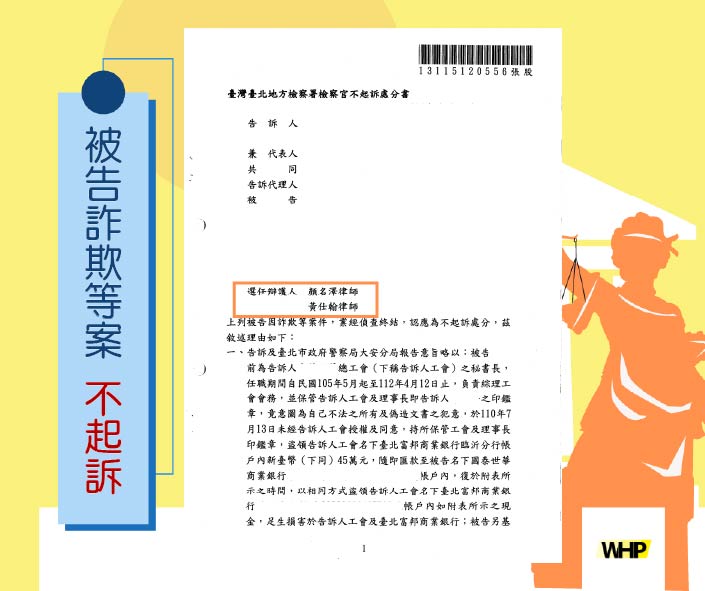
The defendant, namely this firm's client, formerly served as secretary-general of the complainant labor union. During the term of service, the defendant was responsible for overseeing the union's affairs and was entrusted with the seal chops of the and its chairperson. The complainant alleged that the defendant, with the intent to unlawfully obtain property for himself/herself and with the intent to commit forgery, without authorization or consent from the complainant labor union, used the seal chops in his/her custody to unlawfully withdraw funds from the complainant labor union's account and transfer the funds into the defendant's personal account.
The complainant further alleged that, on multiple occasions as shown in the attached schedule, the defendant used the same method to unlawfully withdraw cash from the complainant labor union's account, thereby causing damage to the complainant labor and the bank. The complainant also alleged that the defendant, with the intent to impair reputation, posted messages in a LINE group to accuse the complainant and thereby damage the complainant's reputation. The complainant therefore filed a criminal complaint, alleging that the defendant was suspected of the offenses of uttering forged private documents, unlawful use of seals, fraudulently obtaining property, theft, embezzlement, and aggravated defamation. The defendant firmly denied all of the above accusations.
Prosecutor's Disposition
The investigation into the above-mentioned defendant for alleged fraud and other offenses has been concluded, and it was determined that a non-prosecution disposition should be issued.
Upon investigation, the defendant admitted to receiving certain funds and submitted proof that the funds had been returned to the respective directors. The complainant did not deny that an online investment platform had been initiated, and stated that the funds had already been handled by the defendant and returned to each investor. This was consistent with the defendant's defense, making it difficult to conclude that the defendant had unlawfully withdrawn the above funds.
As to the complainant's allegation that the defendant unlawfully used seal chops to withdraw cash, the complainant based this assertion on the fact that the defendant had withdrawn cash. However, withdrawing cash does not necessarily constitute unlawful withdrawal. The defendant served as chairperson of the labor and was fully aware of matters such as the union's income and disbursement of funds. If there had been any unauthorized disbursement or misappropriation for personal use, questions should have been raised immediately and an audit procedure should have been conducted. However, no audit was ever conducted in this case, nor was any supporting evidence submitted. Merely asserting that the defendant was suspected of the above offenses on the basis that the defendant had withdrawn cash was clearly speculative.
Furthermore, according to the examination of witnesses, withdrawals from the union's account required the consent of the chairperson and were handled by the cashier, while the seal chops were also kept personally by the chairperson. This is sufficient to establish that the funds listed in the attached schedule could only have been disbursed after obtaining the consent of the complainant, namely the chairperson. It is therefore difficult to conclude that the defendant made any withdrawals without consent.
As to the aggravated defamation portion, Article 310, Paragraph 1 of the Criminal Code provides that “a person who, with intent to disseminate to the public, alleges or spreads a matter sufficient to damage the reputation of another shall commit the offense of defamation,” while the first part of Paragraph 3 provides that “a person who can prove the truth of the defamatory matter shall not be punished.” Based on the wording of these provisions, only “facts” can be proven true. It follows that the offense of defamation under Article 310 of the Criminal Code regulates only “statements of fact,” and does not include subjective opinions, comments, or criticism made regarding specific matters based on personal value judgments. Such expression falls within the exemption for “expression of opinion” under Article 311, Subparagraph 3 of the same Code, namely the so-called “fair comment principle.” Therefore, with respect to matters that may be subject to public comment, even if the wording of the criticism is harsh, sarcastic, or sharp enough to make the person criticized feel displeased or affect that person's reputation, it should still be deemed protected by the Constitution and cannot be punished as defamation.
In addition, no other affirmative evidence was found sufficient to establish that the defendant committed the above offenses. Accordingly, the defendant's criminal suspicions should all be deemed insufficient.
(Some details of the case have been adjusted, deleted, or modified to protect the rights and interests of the client.)
Attorneys: Vincent Huang、Ian Yan
-
07.28 2026Case Studies
Criminal Case | No Prosecution for Alleged Counter...
-
07.21 2026Case Studies
Criminal Case | Acquitted of Falsifying Board Meet...
-
07.14 2026Case Studies
Criminal | Non-Prosecution in Neighbor Defamation ...
-
07.07 2026Case Studies
Criminal Case | Prosecution Secured in Mobile Phon...
-
06.30 2026Case Studies
Bank Account Frozen in Taiwan? How to Remove Flagg...
-
06.02 2026Case Studies
Criminal | Perjury Non-Prosecution
-
05.12 2026Case Studies
Criminal | Secret Filming Case Successfully Settle...
-
05.05 2026Case Studies
Criminal | Fraud Aider Identified — Defrauded Fund...
-
04.07 2026Case Studies
Civil | Property Returned but Interior Damaged — P...
-
03.24 2026Case Studies
Criminal | LINE Investment Fraud — Syndicate Buste...
-
03.17 2026Case Studies
Criminal | Procurement Act Violation — Deferred Pr...
-
03.10 2026Case Studies
Civil | Breach of Agreement — Favorable Judgment O...
-
03.03 2026Case Studies
Criminal | Embezzlement & Fraud Case — Non-Prosecu...
-
02.24 2026Case Studies
Owner Failed to Properly Manage Pet Dog That Bit a...
-
02.10 2026Case Studies
Divorce | Successfully Won Custody of Minor Childr...